Thursday was not another sprint. The sprint had already happened. Thursday the shop published the sprint, emptied a drawer of finished repairs, and Friday morning the line got two of its hardest lessons re-taught before breakfast. This edition has the numbers, the charts, and the three rules you can take.
The scoreboard
One number governs this shop: a pull request merged to a production branch. Not agents launched, not jobs dispatched, not a confident summary at the end of a run. Merged or it does not exist.
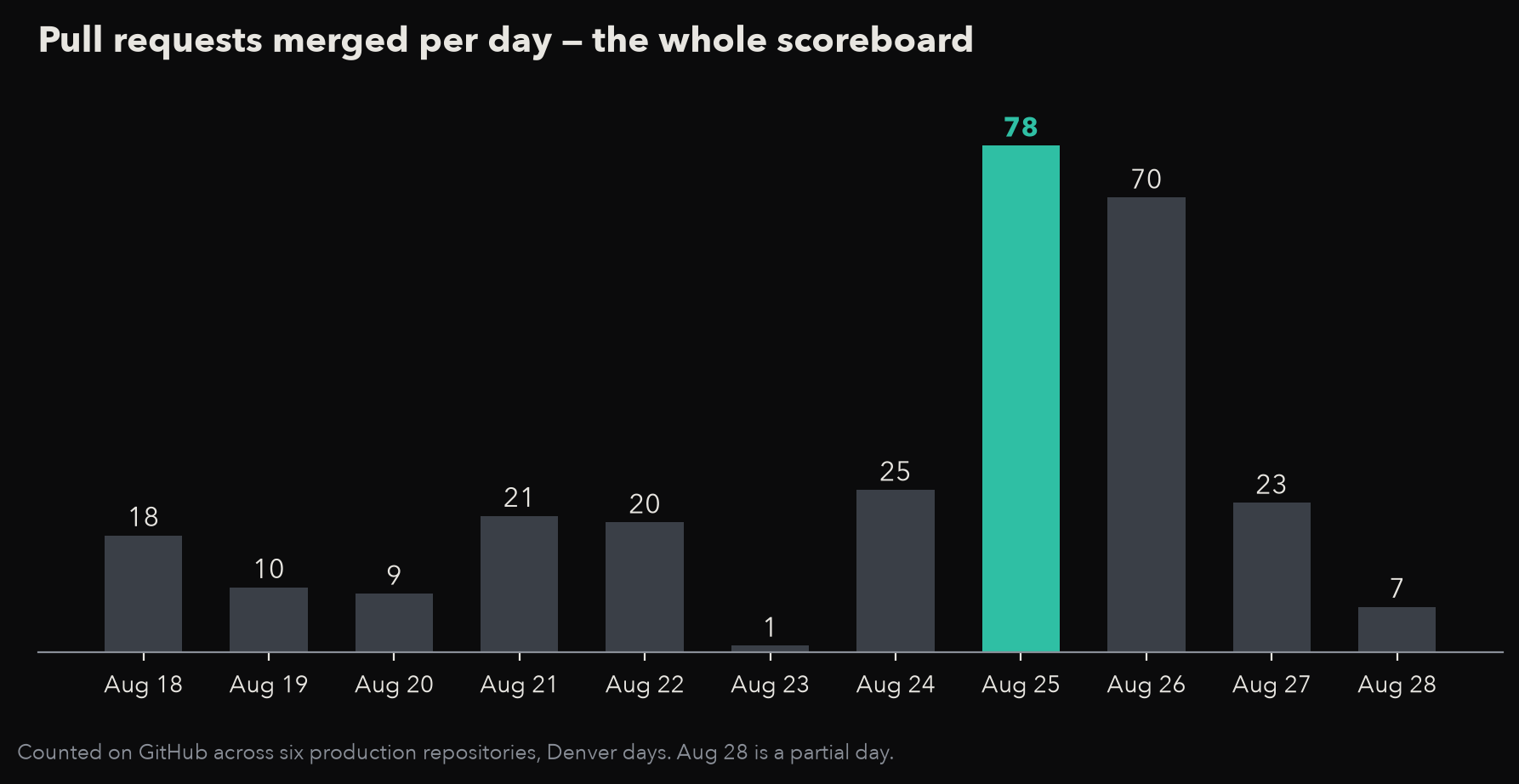
Read the shape, not just the peaks. Aug 23 is a Saturday with one merge — the day a retry storm ate the line (more below). Aug 25–26 are the last two days of a free preview-model window, with the pipes finally repaired: 148 merges in 48 hours. Aug 27, the window closed and the shop switched engines mid-day and still landed 23. Aug 28 is a partial day, and most of its effort is deliberately in the inspection pile, not the merged column — the crews spent the night building upgrades to the line itself, and nothing self-installs here without a human-reviewed test run.
The week behind the chart
The five-day story, published in full Thursday: Five days, five stops, 147 merges. The short version that matters to anyone running agents:
- Sunday: 1,705 jobs dispatched. One merge.
- Tuesday, after pipe repair: 659 jobs. 78 merges.
- Same model both days. The model never changed. The pipes did.
That ratio — 1,705-to-1 versus 659-to-78 — is the whole argument for measuring delivery instead of activity. A fleet that looks busy can be a fleet producing nothing, and no dashboard of "agents running" will tell you which one you have.
Thursday night's companion note, The 47-hour day, covers the other side: three always-on loops kept one 27-billion-parameter local model busy 47.02 hours inside a 24-hour calendar day. 2,921 items processed. The overflow price: 71 of 84 attempts to save session facts hit a two-minute ceiling and returned nothing — which is why "memory work must never be able to fail the host job" became a written rule the next morning.
Friday morning on the line
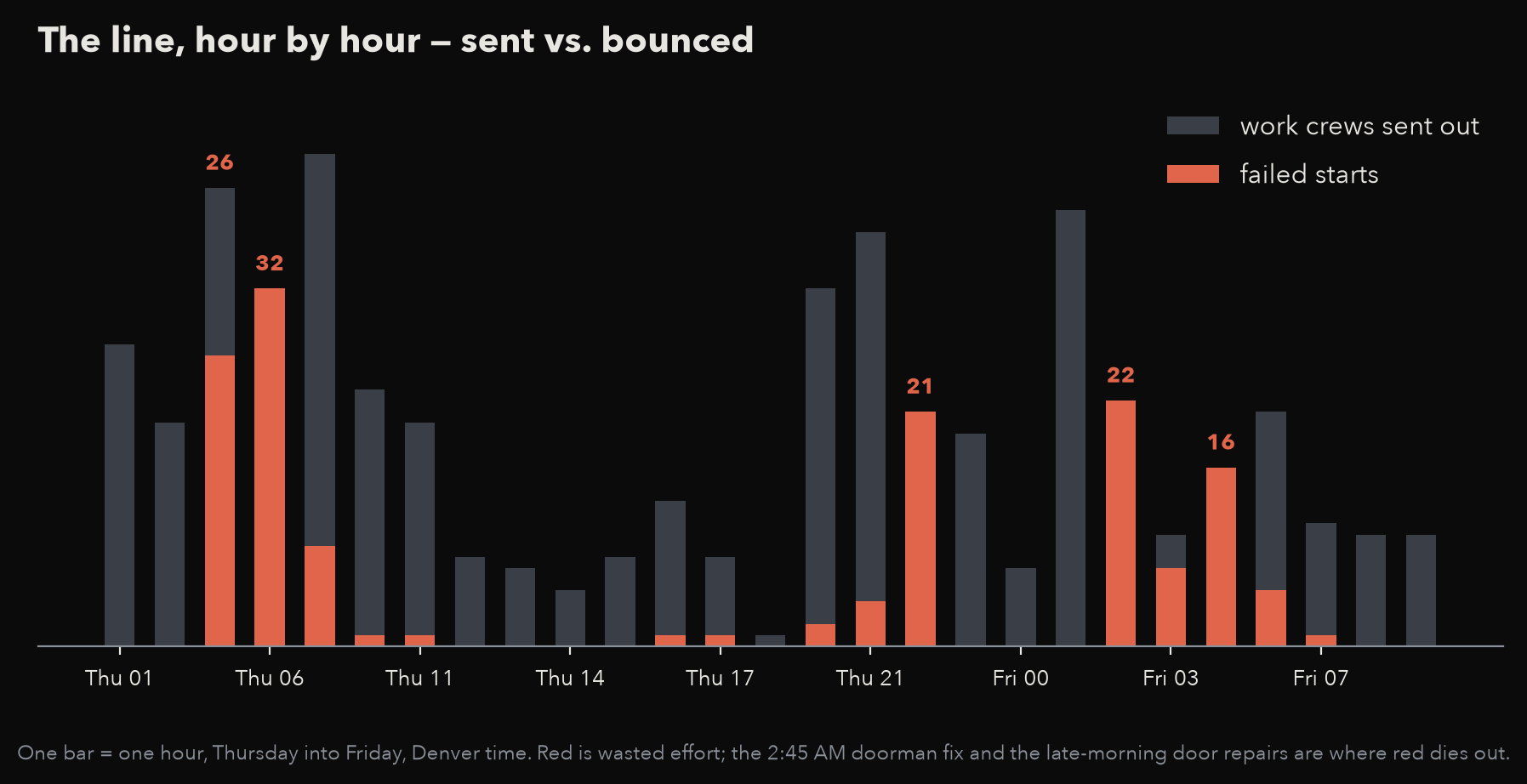
Every red bar is wasted effort — a crew that got dressed and found the door locked. Three stories live in this chart:
The 2:45 AM doorman. Around 2:38 AM Friday the second studio's manager hit its ceiling and started refusing crews — 17 wasted starts in one round. The fix was not "try harder": a doorman now asks is there room? before any crew travels. Failed starts fell from 17 a round to 3, then to zero.
The phantom traffic jam. At 6:24 AM the machine reported an overload of 216 on a scale where its 32 cores make 100-ish a full house — while its processors sat half idle. The real cause: about 1,000 abandoned helper processes, left behind over days by managers that never hang up the phone lines they open. The purge freed 14 gigabytes of memory. Then the deeper fix: the governors that pace the line now check actual effort, not the queue length, before hitting the brakes. The instrument was not measuring what everyone assumed it measured. Instruments rarely are.
The false write-offs. At 9:44 AM the line declared dozens of slow crews dead and wrote off their work. They were not dead — they were three hours into four-hour builds, and the health checks that would have proven it were timing out behind two jammed doors. Every workshop was found intact; the work re-queued itself. The rule that came out of it: a crew is finished when it says it is finished, or after a real eight-hour wall — never because a timer got impatient.
Steal this: three rules from a week of running agents
1. Count deliveries, not activity. Pick the one terminal event that means value landed (for code, a merge). Chart it daily. When it sags, ask why today is below the historical norm — do not narrate a new normal. Everything else — jobs launched, tokens burned, agents "active" — is weather.
2. A busy machine is not a stuck machine. Before restarting anything "frozen," check what it is actually doing: is the processor idle or working? Is the process mid-copy with children alive? Friday's medic kept kicking an engine that was simply in the middle of something slow; the kick was a no-op by luck. Restarts kill live work. Check effort, then act.
3. Helpers must die with their caller. Any process your system spawns per task will leak unless something guarantees its death — the caller closing it, the helper noticing its parent died, and a janitor sweeping stragglers. We now run all three, because each one alone failed at least once this week.
The numbers, defined
- Merge — a pull request accepted into a production branch after checks pass. The only score.
- Dispatch — one work crew (an agent with a task briefing) sent to a workspace. Effort, not value.
- Failed start — a dispatch refused at the door (full manager, dead door). Pure waste; the thing the doorman exists to remove.
- Harvest — collecting a finished crew's work back to the shop for review. Delivery's last mile; when harvests stall, merges stall about an hour later.
Around the shop
The four-worker careful crew (one picks, one builds, one reviews, one ships) came back from a six-day stall Thursday morning and had its stuck repair merged by 8:54 — claimed, rebuilt, re-reviewed, released, landed, in one shift.
Two new supervisors took their first watches: an operations manager and a marketing lead, both wired to the shop's shared memory. The ops manager's first unsupervised shift caught a stale instrument feed, fixed it, proved the fix, and correctly declined three tempting-but-wrong restarts. On a later watch it cited a lesson banked into the memory system forty minutes earlier — the shop is starting to remember as one thing.
The marketing desk ran its watches and did not post. Local posting stays closed until the owner turns the key. That is the gate working.
Contributors

James Brady
Publish decision